A chimney rebuild is warranted when the structure has lost integrity, when an impact, tree limb, or seismic movement has knocked about half the chimney down and put cracks in the rest of it, when mortar joints have…
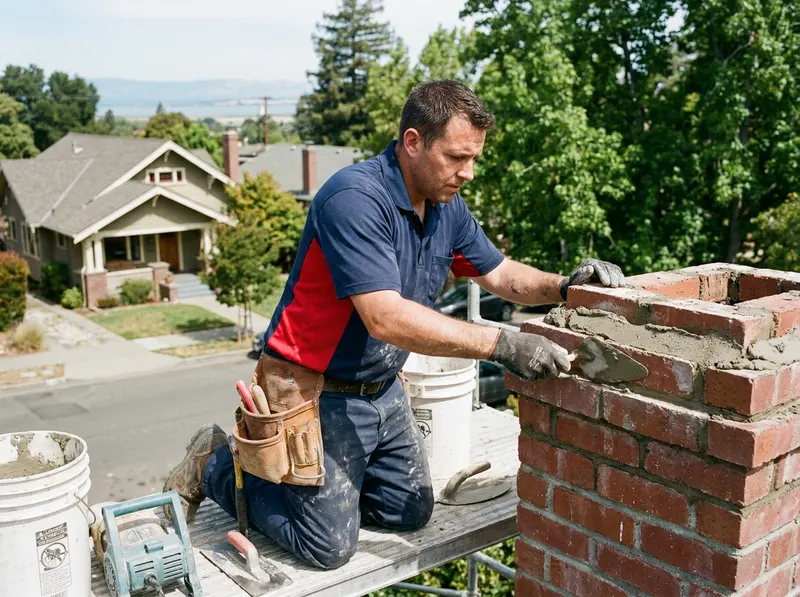
A chimney rebuild is warranted when the structure has lost integrity, when an impact, tree limb, or seismic movement has knocked about half the chimney down and put cracks in the rest of it, when mortar joints have eroded past the point of spot-pointing, or when the crown and upper courses have separated from the flue. A chimney crack repair addresses hairline stress cracks and failing joints; a partial reset restores displaced stones or brick above the roofline; a full chimney replacement rebuilds the entire stack when the masonry can no longer be salvaged. The Chimney Safety Institute of America (CSIA) defines a Level 2 inspection as the standard when a chimney has been altered or damaged, and that inspection scopes which of these three paths applies before any quote is finalized.
Decision-fit is straightforward. If the damage is limited to surface cracks and eroded mortar joints, tuckpointing and crack sealing restore the stack for a fraction of a rebuild cost and preserve the original brick. If individual chimney stones have dropped or shifted but the base and flue remain sound, chimney stones resets rebuild the affected courses without disturbing the lower structure. If the flue liner is cracked, the crown has failed, or a large section has collapsed, a full replacement of the chimney is the safe option, patching a compromised flue leaves a carbon-monoxide and fire path that NFPA 211 clearance rules exist to prevent. The trade-off is cost against certainty: repairs cost less now but return sooner if the underlying masonry is already failing, while a rebuild resets the clock with a new crown, liner, and flashing.
Palo Alto housing stock shapes the work. Older brick chimneys in Professorville, Old Palo Alto, and Crescent Park often show lime-mortar joints that erode faster than modern Portland mix and are more sensitive to seismic movement in Santa Clara County. Mid-century homes in Midtown, Palo Verde, Green Acres, and Ventura more commonly have concrete-block or stone-veneer stacks where crown cracks and flashing leaks drive the damage. Homes near the Stanford foothills and Barron Park see wind-driven rain against exposed upper courses. Access varies too, a College Terrace or Community Center rebuild may need scaffold staging that a single-story ranch does not, which is one reason the on-site estimate matters before a firm chimney rebuild quote is issued.
The sequence is consistent. First, the chimney is inspected to a Level 1 or Level 2 CSIA standard to map cracks, joint loss, and displaced masonry. Second, the findings and photos are documented so the homeowner can see the condition rather than take a verbal 'you're good.' Third, the scope is set, repair, partial reset, or full rebuild, with a written quote. Fourth, damaged courses are removed, new crown and flashing are installed where needed, and the flue clearance is verified against NFPA 211. Edge cases change the plan: a shared party-wall chimney, a designated historic property, or active spalling in freezing conditions can extend timeline and require additional permitting through the City of Palo Alto.
Every job gets a firm, written price after a free on-site visit.
Tell us about your chimney masonry & rebuild job in Palo Alto and we'll send a clear, written quote, usually the same day.
 Sootguard Chimney Sweep