A chimney with no cap is an open shaft roughly 8 to 13 inches wide, the same dimension birds, squirrels, and raccoons read as a hollow tree. Chimney swifts, a protected migratory species under the federal Migratory…
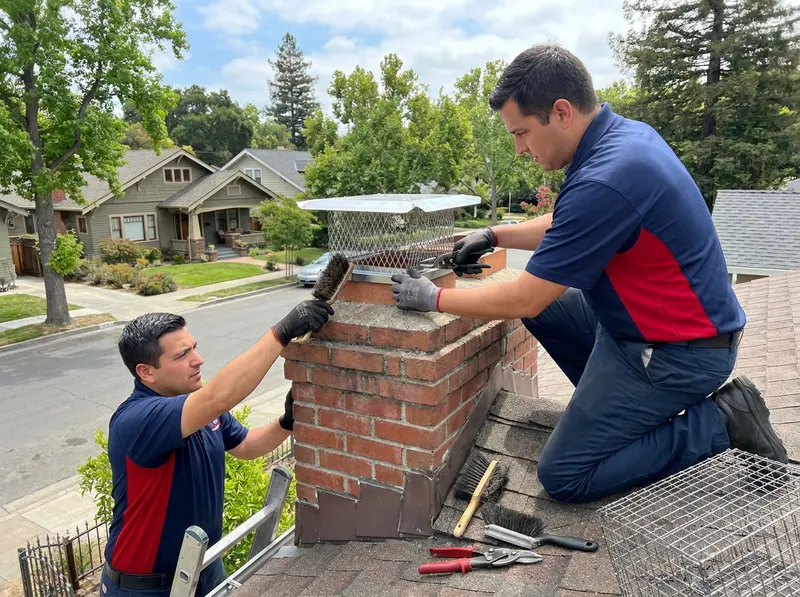
A chimney with no cap is an open shaft roughly 8 to 13 inches wide, the same dimension birds, squirrels, and raccoons read as a hollow tree. Chimney swifts, a protected migratory species under the federal Migratory Bird Treaty Act, commonly nest inside masonry flues in older Palo Alto homes across Professorville and Crescent Park; an active swift nest with eggs or chicks cannot legally be removed until the birds have fledged, so timing matters. When the flue is empty, removing the nest and cleaning out the chimney is straightforward: the crew works from the roof and the firebox, extracts the material, then runs a camera up the liner to confirm nothing is left blocking the draft.
Raccoons are a heavier problem. A female raccoon will drop into an uncapped flue in spring to den and raise a litter, and the scratching, chirring, and smell from the smoke shelf are the usual first signs. Removing a raccoon and her young requires patience and, in some cases, a licensed wildlife operator, because Santa Clara County restricts how wildlife may be relocated. Once the animals are out and the flue is cleaned, the fix that actually keeps the raccoons out is a full-coverage cap, not a screen wedged over the crown. The right choice for most Palo Alto homes is a custom chimney animal guard fabricated to the flue's exact dimensions, built from 316 stainless mesh rather than galvanized steel. 316 stainless is the marine grade: it resists the salt-laden air that drifts across the Peninsula from the Bay and will not bleed rust stains down a light-colored stucco chimney the way galvanized guards do within a few seasons.
Decision-fit comes down to the opening. A single standard flue with a factory-standard crown usually takes an off-the-shelf single-flue cap, which is the faster and cheaper route. A wide masonry crown, a multi-flue chimney, or an unusually shaped opening, common on the older brick chimneys in Old Palo Alto and Community Center, needs a custom, ideally 316 stainless mesh animal spark arrestor built to fit, because a loose or oversized off-the-shelf cap leaves the exact gaps a squirrel exploits. The mesh spacing also matters: a proper spark arrestor uses openings no smaller than 3/8 inch and no larger than 1/2 inch, the range specified under NFPA 211, so it blocks animals and embers without choking the draft. If you only want to keep the raccoons out, a cap with an animal screen is enough; if you also want ember protection for a wood-burning fireplace, the spark arrestor grade is the one to specify.
Every animal removal here pairs with a documented cleanout and a camera-verified report, so the finished flue is photographed rather than described. Any full removal is a good moment to run a CSIA-aligned Level 1 or Level 2 inspection, Level 2 is the standard when there has been a change of condition, and an animal intrusion counts. That report shows whether droppings and nesting acids damaged the liner or crown, which is the kind of thing a vague "we swept it, you're good" visit leaves you guessing about. Homeowners in Barron Park, Midtown, College Terrace, Green Acres, Palo Verde, and Ventura can get some quotes and compare scope; a free on-site estimate confirms the flue size and the exact cap needed before any work is quoted.
Every job gets a firm, written price after a free on-site visit.
Tell us about your animal removal & spark arrestor job in Palo Alto and we'll send a clear, written quote, usually the same day.
 Sootguard Chimney Sweep